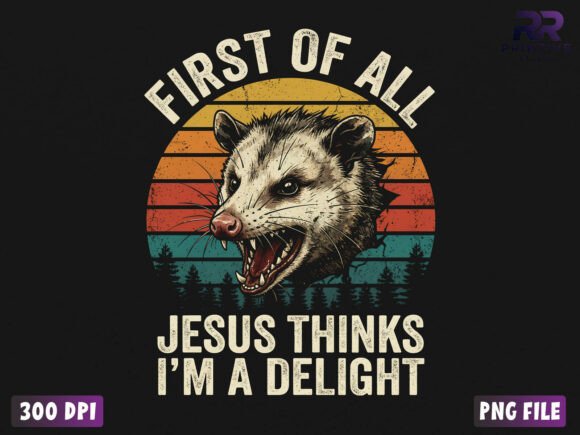
First of All Jesus Thinks PNG T-Shirt Designs
As a graphic designer who’s built brand identities for faith-based small businesses, handmade boutiques, and seasonal print-on-demand launches, I recently evaluated First of All Jesus Thinks PNG for a real client project: a spring-themed “Grace & Grounding” apparel line launching on Etsy and local church gift shops. My goal wasn’t just to assess aesthetics—I needed to know whether this graphic design asset would hold up across t-shirt designs, packaging, social media graphics, and printable wall art without compromising professionalism or emotional resonance.
A First Glance That Feels Intentional, Not Generic
The moment I opened the file, I noticed clean edges, crisp anti-aliasing, and true transparency—no halo, no stray pixels. This isn’t clipart slapped together for bulk resale. The composition balances reverence and approachability: soft serif lettering with subtle hand-drawn texture, gentle spacing, and a quiet visual weight that reads as thoughtful—not preachy. It lands somewhere between modern design and warm handwritten charm, making it ideal for brands rooted in authenticity rather than trend-chasing.
Where It Shines in Real Client Work
First of All Jesus Thinks PNG excels where emotional clarity meets visual simplicity:
- T-shirt design: Works beautifully on heather grey, oatmeal, and navy tees—especially when paired with minimalist layout and breathable negative space.
- Packaging design: Adds warmth to kraft gift boxes, tissue paper stamps, and hang tags for handmade business branding.
- Social media graphics: Scales cleanly for Instagram carousels and Pinterest pins—its contrast holds up even in thumbnail view.
- Printable design: Prints crisply at 8x10” and 11x14” for devotional wall art or church event handouts.
- Cricut project: Cuts flawlessly from vinyl or iron-on material thanks to smooth vector-aligned outlines (if SVG is included) or high-res PNG paths.
- Product mockup: Looks natural on lifestyle shots—tote bags, mugs, journals—without demanding visual dominance.
It’s especially effective in themed collections: Easter campaigns, new believer welcome kits, women’s ministry merch, or small group study bundles. As part of a broader brand identity, it supports—not replaces—logo design by reinforcing core messaging through consistent tone and typographic rhythm.
Where to Use It With Care
This isn’t a one-size-fits-all SVG design. Its expressive texture and moderate stroke weight mean it can lose legibility below 1.5 inches tall—so avoid using First of All Jesus Thinks PNG as tiny favicon-sized icons or fine-print footers. It also competes in busy layouts: place it over solid light or dark backgrounds only—not complex photos or gradient overlays unless you’ve pre-tested contrast.
It doesn’t suit minimalist corporate materials (think law firms or tech startups), nor does it align with ultra-sleek branding that relies on razor-thin sans-serif fonts or monochrome palettes. If your client’s visual hierarchy depends on stark neutrality, this asset may soften their message unintentionally.
How It Shapes Brand Perception
In my client’s “Grace & Grounding” launch, First of All Jesus Thinks PNG became the emotional anchor—not the logo, but the recurring motif that tied everything together. On Instagram posts, it added sincerity without clutter. On product labels, it elevated perceived value compared to stock phrases. And because it’s clearly crafted (not algorithm-generated), it subtly signals care and intentionality—key drivers of trust for faith-based small business branding.
Readability stays strong across devices when sized appropriately, and its tonal consistency helps unify editorial design, web design, and marketing visuals—even when used alongside varied font pairings. I tested it against serif, sans serif, script, and display fonts; it harmonizes best with warm serifs (like Playfair Display) and grounded sans serifs (like Montserrat Light), but clashes with overly decorative or condensed typefaces.
Practical Designer Notes Before You Deploy
Before adding First of All Jesus Thinks PNG to any commercial design, here’s what I always check:
- Test in black and white: Confirm no detail vanishes when color is removed—critical for embroidery or single-color screen printing.
- Check contrast on light/dark backgrounds: Use WCAG guidelines or browser dev tools to verify readability at 16px+ size.
- Preview at multiple scales: Zoom out to 25% to simulate mobile feed viewing; zoom in to 200% to inspect edge integrity.
- Place on real mockups: Don’t rely on flat previews—drop it into a t-shirt mockup, sticker sheet, or Canva template to gauge balance and presence.
- Review file formats: If SVG is included, confirm paths are editable and ungrouped. If PNG-only, verify resolution is ≥300 DPI at intended print size.
- Inspect transparency: Look for stray semi-transparent pixels around letters—these cause halos in sublimation design or digital ads.
- Confirm commercial license: Especially for print-on-demand sellers or Etsy product listings—verify usage rights cover unlimited end products, not just personal use.
Final Verdict for Creative Professionals
First of All Jesus Thinks PNG is more than a t-shirt design—it’s a versatile creative design asset with quiet confidence. It performs reliably across digital product, printable design, and physical merchandise when matched to the right audience and context. For designers supporting churches, Christian creatives, homeschool co-ops, or values-driven small businesses, it’s a rare find: spiritually resonant without sacrificing craft, warm without veering into cliché.
Used intentionally—as part of a cohesive design bundle, paired with complementary illustration or typography, and stress-tested for real-world output—it strengthens brand consistency, deepens audience engagement, and adds emotional polish to otherwise functional marketing visuals. Just remember: great design assets don’t replace strategy—they amplify it. So choose wisely, test thoroughly, and let First of All Jesus Thinks PNG serve the story your client needs to tell.