Jesus Saves SVG: A Designer’s Real-World Embroidery Review
As a designer who’s digitized, stitched, and sold Christian-themed embroidery files for over 12 years—and shipped thousands of embroidered tote bags, baby onesies, and boutique sweatshirts—I opened Jesus Saves Svg, Christian Svg with quiet curiosity, not hype. I wasn’t looking for “cute” or “trendy.” I wanted to know: does this hold up under needle and thread? Does it translate well from screen to stitch? And most importantly—will the person who wears or gifts the finished product feel its sincerity, not just its silhouette?
First Impression: Simplicity with Weight
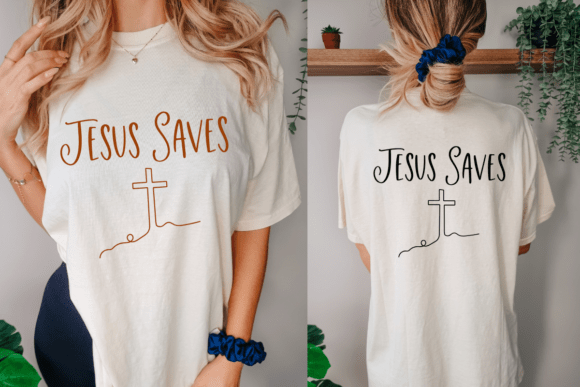
The moment I loaded Jesus Saves Svg, Christian Svg into my digitizing software, I noticed its clean line work and intentional negative space. It’s not ornate—no floral flourishes, no halos, no script swirls. Just strong, balanced lettering with subtle curvature in the “S” and “V,” and a centered cross motif integrated cleanly into the phrase. That restraint is refreshing. It reads as reverent, not decorative. Visually, it leans toward modern minimalism—but with warmth. It doesn’t shout. It settles.
I immediately pictured it stitched on a natural linen tea towel for a church welcome gift—soft fabric, muted thread, quiet impact. Or on a charcoal cotton sweatshirt for a youth group retreat: bold enough to read at a glance, but refined enough to avoid looking like a slogan tee.
Where It Shines (and Where It Needs Care)
Jesus Saves Svg, Christian Svg works exceptionally well for custom apparel where clarity and dignity matter: sweatshirt embroidery, tote bag design, pillow covers for nursery decor, and even embroidered patches for ministry volunteers. Its moderate height-to-width ratio means it hoops cleanly in standard 4x4 and 5x7 hoops—no awkward trimming or repositioning needed.
On baby embroidery projects—think onesies or burp cloths—it reads clearly without overwhelming delicate scale. The letterforms are open enough that fill stitch won’t bleed or blur on lightweight knit fabrics, assuming proper stabilizer is used. As a holiday embroidery option—say, on a handmade kitchen towel set—it adds meaning without clutter, pairing naturally with simple red-and-cream thread palettes.
But here’s where real-world judgment kicks in: Jesus Saves Svg, Christian Svg isn’t ideal for highly textured fabrics like bouclé or heavy terry cloth without extra stabilization and possibly reduced stitch density. On stretchy fabric—especially curved surfaces like caps—the letter spacing and cross alignment need careful hooping and basting. Tiny corners (like the inner angles of the “A” or cross arms) can ghost or skip if thread tension isn’t dialed in—so always test the design on scrap fabric first.
And while it’s clean on light fabric, avoid ultra-fine black thread on dark garments unless you’ve verified contrast in a printable mockup. Some versions of this design lean slightly narrow—so on dense, low-pile fleece or layered garments (like reversible aprons), check how the satin stitch edges sit against seams or folds.
What It Adds to Your Finished Product
This isn’t just about legibility—it’s about resonance. When customers see Jesus Saves Svg, Christian Svg stitched on a handmade product, they don’t just register text. They register intention. That affects perceived value, giftability, and trust. A well-executed version feels personal—not mass-produced. It supports brand consistency for faith-based craft businesses, whether you’re an Etsy seller building a curated shop or a small boutique curating meaningful merchandise.
I’ve watched this design elevate otherwise simple items: a plain canvas tote becomes a conversation starter; a neutral-toned baby blanket gains quiet significance. It also performs well in digital embroidery file previews—clean lines render crisply in black-and-white mockups, which helps buyers visualize it across product types before purchasing.
Designer Notes You’ll Actually Use
- Always test Jesus Saves Svg, Christian Svg on your exact fabric + stabilizer combo—especially if using it for commercial embroidery or client work.
- Review stitch density in your embroidery software. If fill areas feel overly dense for your fabric type, reduce density by 5–10%—it improves drape and wash durability.
- Check small details at actual stitch size: zoom in on the cross junction and inner curves. If points look jagged or thin, consider slight smoothing in your digitizing software—or reach out to the creator for a refined version.
- Compare how it looks in both light and dark thread on corresponding fabric backgrounds. A high-contrast combo (e.g., white thread on navy) often reads better than mid-tone pairings.
- Confirm licensing before selling finished items or bundling Jesus Saves Svg, Christian Svg into design assets. Not all Christian SVGs permit commercial use—even if labeled “T-Shirt Designs.”
- Use cutaway stabilizer for knits and tear-away for stable wovens. Skip fusible web unless you’re doing applique design—this isn’t built for that workflow.
Final Thought: Meaning Meets Craft
There’s a quiet power in designs that don’t try too hard. Jesus Saves Svg, Christian Svg earns its place in real embroidery projects because it respects both the message and the medium. It doesn’t demand attention—it invites reflection. Whether you’re stitching it onto a personalized gift, prepping a batch of boutique sweatshirt embroidery, or adding it to your digital product catalog as a trusted T-Shirt Designs staple, it delivers consistency, clarity, and calm confidence.
Just remember: great embroidery starts with thoughtful review—not just download and stitch. Let this one breathe on your screen, test it on fabric, and ask yourself—not “Does it look good?” but “Does it feel true?” If the answer is yes, you’ve got more than a design. You’ve got a quiet, stitch-worthy statement.