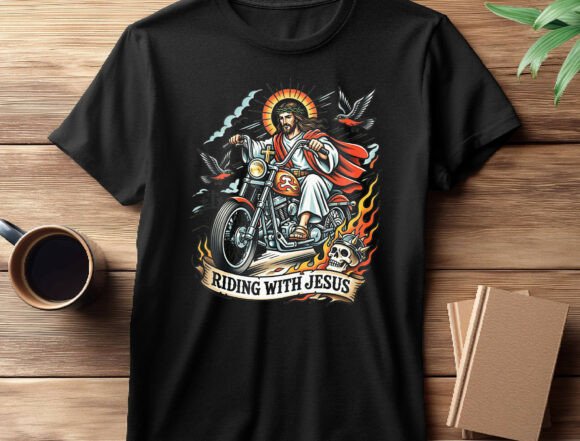
Traditional Tattoo Jesus on Motorcycle T-Shirt Designs
First Impression: Bold, Narrative-Driven, and Unapologetically Character-Full
When I opened Traditional Tattoo Jesus on Motorcycle for a recent branding project with a downtown motorcycle-themed coffee roastery—think “Holy Grail Roast” serving nitro cold brew from vintage gas-can mugs—the design hit like a well-timed chime: instantly recognizable, rich in texture, and deeply evocative. It’s not minimalist. It’s not safe. It’s a graphic design asset that leans hard into traditional American tattoo iconography: bold black outlines, dense dotwork shading, symmetrical composition, and symbolic contrast (divinity meets rebellion). The mood is reverent yet rebellious, nostalgic yet contemporary—ideal for brands rooted in authenticity, craftsmanship, and local storytelling.
Fits Best With: Artisanal, Edgy, or Story-Forward Local Businesses
This isn’t a one-size-fits-all illustration. It thrives in contexts where personality *is* the brand strategy. Think handmade soap makers using it as a subtle foil on lavender-and-leather scent labels; boutique apparel shops weaving it into limited-edition holiday packaging; or a family-run tattoo parlor’s seasonal candle line (“Sanctuary Scent: Frankincense + Iron”). It reads as premium when paired with uncoated kraft paper, soy-based ink, and hand-stamped accents—but feels jarring beside sterile white labelling or clinical medical aesthetics. For small business branding, it signals confidence, cultural fluency, and visual courage—not just decoration, but narrative reinforcement.
Where It Earns Its Keep Across Real Business Touchpoints
- Product labels: Works powerfully as a central emblem on jarred hot sauce, craft beer cans, or ceramic mug tags—especially when isolated on a circular die-cut or framed by border motifs.
- Packaging design: Adds instant shelf appeal to gift boxes, bakery bags, or apothecary tins. On matte black boxes with gold foil stamping? Striking. On busy floral backgrounds? Overwhelming.
- Social media graphics: Scales beautifully for Instagram carousels announcing seasonal drops, behind-the-scenes reels of label printing, or TikTok unboxings—its high-contrast linework holds up even at thumbnail size.
- Printable design & promotional materials: Translates cleanly to thank-you cards tucked inside orders, hang tags on leather goods, or posters for local pop-ups. As a digital product, its clean vector structure makes it easy to resize without distortion.
- Brand identity expansion: When adapted thoughtfully—say, simplified into a monogram for stitching on aprons or reduced to a single-line variant for website favicons—it becomes part of a cohesive visual language, not just a standalone clipart element.
Real Impact on Customer Perception & Trust
For local business owners, every visual cue builds credibility. Traditional Tattoo Jesus on Motorcycle strengthens first impression by signaling intentionality: this isn’t generic stock art—it’s curated, culturally grounded, and stylistically resolved. That perception lifts product recognition (shoppers remember the motif across your stickers, menu boards, and tote bags), sharpens visual hierarchy (it naturally draws the eye before supporting text), and deepens emotional connection—especially among audiences who value heritage craft, subcultural resonance, or spiritual irony. In packaging design, it elevates perceived quality; in social media graphics, it boosts engagement through distinctiveness; in print marketing visuals, it adds editorial weight.
Smart Placement: Where This Asset Shines Brightest
Use it as a hero graphic on limited-run product mockups, as a decorative brand element on café chalkboard menus, as an accent on boutique shopping bags, or as the focal point of a seasonal campaign banner (“Ride Into Lent” for a bakery’s pretzel cross promo). It excels in contexts where space allows breathing room—on large-format posters, oversized hang tags, or the front panel of rigid gift boxes. As SVG design or high-res PNG design, it integrates smoothly into Canva templates, Shopify product pages, and print-ready dielines.
Cautions: Where Context Demands Restraint
Avoid forcing it into cramped ingredient-heavy food labels, legal disclaimers, or minimalist luxury skincare branding—here, it competes rather than complements. Don’t place it over low-contrast backgrounds (e.g., light gray on off-white) without testing legibility. Steer clear on formal corporate collateral (B2B proposals, investor decks) or children’s product lines unless intentionally subversive. And never assume it works at 6mm height on a tea bag tag—test early, test often.
Practical Brand Designer Notes Before You Commit
- Always preview Traditional Tattoo Jesus on Motorcycle on real packaging mockups—not just screen previews—to assess scale, balance, and tactile impact.
- Check black-and-white output: Does the dotwork hold? Does the silhouette read clearly when inverted?
- Test it beside your brand fonts—does it harmonize with serif elegance, sans-serif clarity, script warmth, or handwritten charm?
- Confirm commercial license coverage: Is it cleared for physical product sales, resale, and client work—or only personal use?
- Inspect transparency: Does the PNG design have clean edges? Does the SVG design allow easy recoloring for brand palette alignment?
- Compare against competitor packaging: Does it differentiate—or accidentally echo another local brand’s visual rhythm?
- Review print quality: If ordering bulk labels, request a press proof—halftone rendering can flatten fine tattoo detail.
Final Thought: A Design Asset With Intent, Not Just Aesthetic
Traditional Tattoo Jesus on Motorcycle isn’t just another T-Shirt Designs download. It’s a culturally literate, technically robust graphic design asset—one that earns its place in serious small business branding when matched with thoughtful strategy. Whether anchoring a candle brand’s “Sacred & Gritty” rebrand or adding soul to a food truck’s merch line, it delivers more than decoration: it delivers voice, values, and visual conviction. For creative entrepreneurs building something real—and local—that’s exactly what strong brand identity demands.